
What is South African house music? It is house with local roots, most often Afro House, which combines a four-four kick and deep basslines with liberal percussion and soulful vocals. The name covers several related styles rather than one sound.
A listener who hears a log drum track tagged as house, then a kick-driven Afro House set, may assume one of them is mislabelled. Neither is. The map below separates the styles, and the wider south african club music guide shows how they sit in the club landscape.
What the label actually covers
Afro House is a sub-genre of house music that was established in South Africa in the 1990s, according to Loopcloud’s history of Afro House. The same source says it gained popularity in South Africa and Angola in that decade. So “South African house” is best read as a family of styles that share house foundations, not a single genre with one tempo and one template.
The contrast table below corrects the most common mix-ups between the main styles.
| Style | Sound markers | Relationship to house | Planning use |
|---|---|---|---|
| Afro House | Four-four kick, deep basslines, repetitive drum patterns, liberal percussion, soulful vocals; typically 100–120 bpm | A house sub-genre, derived from Kwaito and House | Start here when searching for the core South African house sound |
| Kwaito | Grew out of Bubblegum and took on House and Hip Hop attributes | A parent of Afro House, not a house sub-genre itself | Treat it as the older, separate style that fed house |
| Amapiano | Log drum sound, synth chords, 16th note shakers; characterised by a lack of kick drums | Takes direct influence from House and Kwaito | Do not search for it using kick-driven Afro House tags |
| Afrobeats | A different style born in West Africa | Not part of South African house | Exclude it when building a South African house playlist |
The sound descriptions and tempo range come from Loopcloud’s Afro House origins article.
Sound and craft
The practical tell for Afro House is the combination of a steady four-four kick drum with deep bass and heavy percussion layering. Most Afro House is made at a tempo between 100 bpm and 120 bpm, so a set in this style tends to feel more rolling than driving. Treat that range as typical rather than a rule, since producers vary it.
- Drums and percussion: repetitive drum patterns carry the groove, with percussion added liberally on top of the kick.
- Bass: deep basslines anchor the track and are also a trait that Afro House shares with amapiano.
- Vocals and melody: Afro House often contains soulful vocals and melodies that take influence from a range of African music styles.
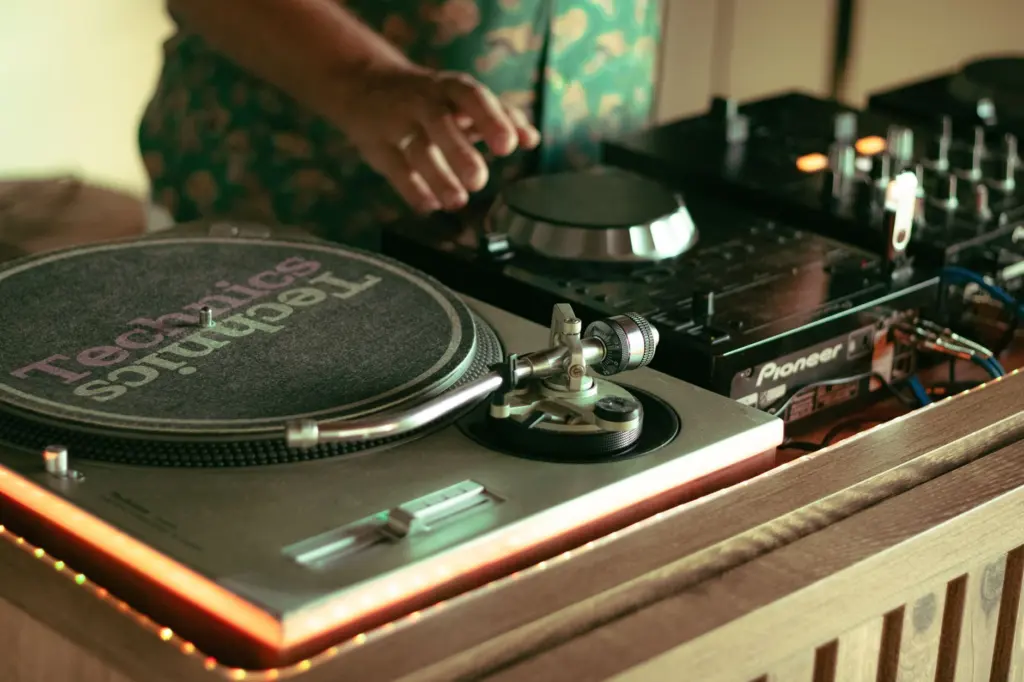
For a DJ, that structure makes the style mix-friendly. The mixer and decks are where the repetitive patterns get blended into long sets.
Subgenres on the map
Afro House
Afro House is the anchor style. It is commonly considered to have derived from Kwaito and House, and its vocals and percussion are what separate it from a generic four-four house track. It is commonly associated with amapiano, Kuduro and Gqom, but association is not the same as sharing a sound.
Deep house
Deep house enters the South African story through producers who blend it with Afro House. Black Coffee has built a career creating and DJing his own take on Deep House and Afro House, which shows how permeable the boundary is. A listener who wants the Johannesburg-focused view can read the guide to south african deep house.
Amapiano
Amapiano was also established in South Africa and takes direct influence from House and Kwaito. Its identifiers are the trademark log drum sound, synth chords and 16th note shakers, and it is characterised by the lack of kick drums. That last point is the main reason it should not be filed under kick-led Afro House, even though it shares deep basslines with it. Details come from Loopcloud.
Where kwaito fits
Kwaito is not house, but house cannot be explained without it. Loopcloud says Kwaito is said to have stemmed from Bubblegum, South Africa’s pop style of the 1980s. Kwaito then picked up where Bubblegum left off and incorporated more musical attributes of House, along with Hip Hop.
The house influence was already audible in late 1980s Bubblegum, which had a four-on-the-floor kick and a groovy bassline. Kwaito’s rise was driven by the lifting of political and economic sanctions when Nelson Mandela was elected in 1994. In 1995 Arthur Mafokate’s breakout hit featured the classic four-four kick and sold over 150,000 copies. For the full story of that scene, see the history of kwaito.
The practical takeaway: when a source calls Afro House a child of Kwaito and House, it means the slower, soulful, kick-led sound inherited kwaito’s local flavour and house’s four-four engine.
How it differs from house elsewhere
South African house shares the house skeleton, meaning the four-four kick and the deep bass. The difference lies in what is layered on top. Afro House leans on liberal percussion and on soulful vocals and melodies drawn from African music styles, and its roots in Kwaito give it a lineage that house scenes elsewhere do not share.
The exchange has also run across borders. Louie Vega had been visiting South Africa throughout the 1990s, the decade in which Afro House was established. In the early 2010s, Culoe De Song and others started to create Afro House with a darker, more minimalist feel, per Loopcloud, which shows the style bending toward international club tastes without losing its identity.
One more correction: Afrobeats refers to a different style of music born out of West Africa, so it is not a synonym for Afro House.
Timeline, artists and labels
The records that Loopcloud highlights give a workable timeline of how house took root and travelled. Read it as a press-documented sequence, not a complete history.
- 1990s: Afro House is established in South Africa and gains popularity there and in Angola.
- 1999 to 2000: Afro Medusa’s 1999 track Pasilda goes on to top the charts in 2000.
- 2003: Malaika’s Destiny is a huge chart success.
- 2008: Iku releases Mirror Dance on Yoruba Records, the label founded and operated by Osunlade.
- 2009: Black Coffee’s album Home Brewed is widely considered a musical landmark for Afro House.
That last entry matters because previous Afro House releases had achieved limited success outside South Africa and Angola. Black Coffee is the clearest example of a DJ and producer carrying the style, along with his take on deep house, to wider audiences. Yoruba Records is the clearest example in the pack of a record label giving the style an international release channel.
Frequently asked questions
| Question | Answer |
|---|---|
| Is amapiano a type of house? | Amapiano takes direct influence from House and Kwaito but is defined by a log drum and a lack of kick drums, so it is usually treated as a related style rather than Afro House. |
| What tempo is Afro House? | Most Afro House sits between 100 bpm and 120 bpm, according to Loopcloud. Treat it as a typical range, not a limit. |
| Is Afrobeats the same as Afro House? | No. Afrobeats is a different style born in West Africa. |
| Where did Afro House start? | It was established in South Africa and gained popularity there and in Angola during the 1990s. |