
South African club music splits first by feel: choose gqom for raw, rhythm-led intensity or afro house for melody and a smoother, soulful mood. Amapiano, kwaito and deep house then fill in the wider picture, so start with the sound you want tonight.
This hub maps those choices and sends you on to the detailed guides, beginning with the amapiano meaning explainer. Read the decision list first, then follow whichever branch matches the way you listen, dance or play records.
Choosing where to start
The quickest way into this music is to decide what you want from a track before you decide on a genre. The genres differ less in country of origin than in what they ask of you: some push rhythm to the front, some lean on melody, and some are mainly a way into the older sounds that shaped the rest.
A genre comparison published by Elite Flair draws the clearest supported contrast. It describes afro house and gqom as two South African genres, with afro house often incorporating melodic elements and harmonies while gqom focuses more on rhythm and beat. That single axis, melody against rhythm, is the most useful first filter.
Questions to ask yourself
- Do you want to feel the drums or follow a tune? If the drums matter most, begin with gqom. If you want a hook, a chord change or a vocal to hold on to, begin with afro house or the amapiano playlists described later.
- Will you be listening closely or dancing? Dark, hypnotic, repetitive patterns suit a floor and headphones alike, but they can feel relentless in a quiet room. Smoother, more soulful material is easier to leave on in the background.
- Do you want context or immediacy? If you want to understand where a sound came from, start with the older roots. If you want to hear what people are playing now, start with the current playlists.
- Do you play records or make beats? The DJ and production sections below are written for that reader, and the choice there is mostly about which role a track plays in a set.
A short decision list
- You want the hardest, most percussive sound. Start with gqom. The gqom meaning guide explains the term and the sound before you dive into individual tracks.
- You want melody and a smoother mood. Start with afro house, then move sideways into deep house, both covered in the house section below.
- You want the sound that fills current South African playlists. Start with amapiano. The amapiano log drum guide covers its signature low end, and the amapiano vocalists page covers the voices that carry the tracks.
- You want the lineage. Start with kwaito, which the same genre comparison names as one of the roots afro house draws on.
- You want to go out. Skip ahead to the Johannesburg section for the club and neighbourhood guides.
The genres in the family
South African club music is not one genre but a set of neighbouring styles that share a country, a dance floor culture and a habit of borrowing from each other. The core members covered here are house and its afro variants, kwaito, gqom and amapiano, with the DJ as the person who connects them in a room.

House and afro house
House music is the broadest label in the group, and its South African form is usually called afro house. The Elite Flair comparison says afro house originates in Southern Africa, particularly South Africa, and draws on house music, kwaito and traditional African music. That mix explains why it tends to sound more harmonic than gqom.
The same piece describes afro house as smoother and more soulful, and it cites Black Coffee as an afro house artist who has achieved international stardom. For a first listen, treat afro house as the welcoming entry point: it asks the least of an unfamiliar ear. The full definition lives in the guide on what is south african house music.
Kwaito
Kwaito matters in this overview mainly as a root. The supported link is that afro house draws on it, which makes kwaito the genre to visit if you want to hear what sits underneath the house sounds of today. It is the right starting point for readers who prefer to read a genre’s story before they hear its descendants.
The kwaito meaning page defines the term, and the history of kwaito page is the place for dates, places and the people involved. This hub deliberately does not pin down origin years, because a hub summary that compresses a genre’s timeline into a single line tends to mislead.
Gqom
Gqom is a South African genre that the Elite Flair comparison characterises as raw and minimalistic. It is marked by heavy bass, repetitive drum patterns and dark, hypnotic beats, and it relies heavily on digital production. Those traits give it an unmistakable identity: nothing in it is there for decoration.
The same source says gqom’s sound has piqued the interest of DJs and producers around the world, which is a useful signal if you assume a local style has to stay local. If you want the background rather than the sound, read the history of gqom.
Amapiano
Amapiano is the genre most listeners meet through streaming. A Spotify playlist titled Best of South African Amapiano, Afro-Pop and Soulful House Music groups it with afro-pop and soulful house and describes the contents as afro-accented electro and dance grooves from southern Africa. The artists it names include Sun-El Musician, Prince Kaybee, Black Coffee, Tresor, Kabza De Small and Msaki.
That grouping tells you something practical: amapiano is usually met alongside melodic, soulful neighbours rather than alongside gqom’s dark minimalism. For the genre’s own story, the history of amapiano is the page to open.
Telling gqom and amapiano apart
Gqom and amapiano are the two names most often confused by newcomers, and the practical difference is where the weight sits. Gqom puts rhythm and beat first; amapiano, as the playlist evidence shows, travels with the melodic, soulful side of South African dance music.
The supported description of gqom is specific: heavy bass, repetitive drum patterns, raw and minimalistic beats. The Elite Flair comparison sets that against afro house, which it calls more melodic, more harmonic, smoother and more soulful. Because amapiano is curated beside afro-pop and soulful house on the Spotify playlist, the sensible listening heuristic is to expect it nearer the afro house end of that scale than the gqom end. That is a guide to what you will probably hear, not a rule that every track obeys.
What to listen for
- The role of the drums. In gqom, repetitive drum patterns are the content. If you can strip away everything but the drums and the track still works, you are probably hearing gqom.
- The role of voices and chords. If a vocal or a harmony carries the track, you are in the melodic neighbourhood where afro house and amapiano playlists live.
- The mood on a long listen. Dark and hypnotic wears one way over a long session; smooth and soulful wears another. Match the genre to how long you plan to stay with it.
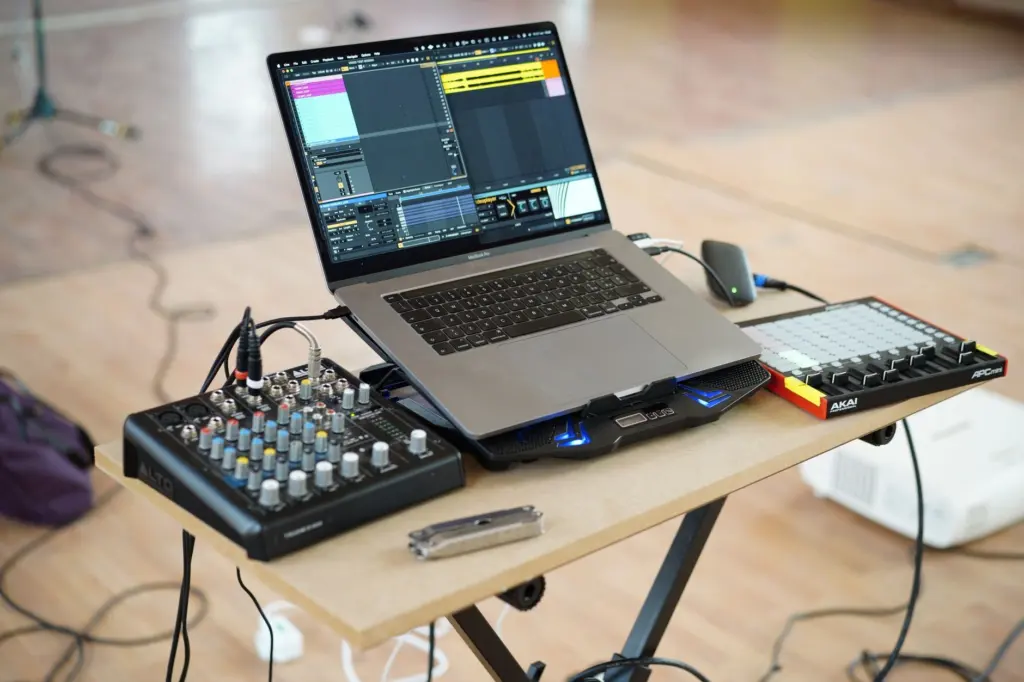
Production is a second dividing line. The comparison says gqom is more minimalistic and relies heavily on digital production. A laptop, a controller and a small mixer are therefore a reasonable picture of the workspace behind this sound, although the photograph below is an illustration and not a record of any particular studio.
If you want a fuller side-by-side, the dedicated gqom vs amapiano comparison goes through the differences in more detail than this hub can.
House, deep house and afro tech
House is the bridge between the older South African sounds and the club sets heard today. Within it, three labels cover most of what you will see on streaming platforms: afro house, deep house and the tech-leaning variants.
A Spotify album called Best of Afro House carries the tags South Africa Deep House and Afro Deep House Beats, and it runs to 8 songs in 27 minutes 42 seconds. The overlap in the tags shows how loosely these labels are applied: the same record can be filed as afro house and as deep house. Treat a short compilation of that length as a sampler, not a definition.
Choosing between the house branches
- Afro house suits listeners who want the melodic, harmonic and soulful side, and who like the idea that kwaito and traditional African music sit in its background.
- Deep house suits listeners who prefer a calmer register. The south african deep house guide sets out how the style is understood locally.
- Afro tech suits listeners who want the genre boundaries explained before they start. The guide on what is afro tech covers how it relates to afro house.
Black Coffee is the clearest example of how far the house side of this scene travels, since the genre comparison cites him as an afro house artist who has achieved international stardom. He also appears among the artists named on the amapiano playlist, which is a further reminder that the genre lines are porous and that artists move between them.
DJs and the booth
In club music the DJ is the person who turns a catalogue of genres into a night. The supported evidence here is about reach: gqom’s sound has drawn the interest of DJs and producers worldwide, and afro house artists such as Black Coffee have reached an international audience.
For anyone building a set, the useful point from the genre contrast is that tracks do different jobs. A rhythm-led track, in the gqom manner, gives a room a pulse to lock on to. A melody-led track, in the afro house manner, gives it something to sing along with. Treating those as two tools, not two competing camps, is a sound way to plan a transition between them.
If you are new to DJing, start by learning the difference between tracks you would play to build energy and tracks you would play to give the room a rest. The genre contrast here gives you a ready-made sorting rule: put rhythm-first tracks in one crate and melody-first tracks in another, then practise moving between them.
Club music in Johannesburg
Genre labels only go so far, because club music lives in rooms, neighbourhoods and the routes people take to reach them. Johannesburg is the setting this site is built around, and the venue and neighbourhood guides are where the genres meet real nights out.

For a ranking of rooms, the best clubs in johannesburg guide is the place to look. For a township-focused view of where people go and what they hear, the soweto nightlife guide covers the area on its own terms. Use the first when you want a list of options, and the second when you want a sense of place.

When you pick a night, choose by genre first and venue second. A room that books melodic house will feel very different from one built around gqom’s repetitive drum patterns, even if both are described simply as clubs playing South African music. Check what a night is billed as before you travel.

Sound systems and the crowd
Heavy bass is one of the defining features of gqom, and bass is a physical experience that depends on the sound system as much as on the track. A rhythm-led genre rewards a big rig, so if gqom is your reason for going out, the quality of the speakers is part of the choice of venue.

Melodic genres ask for something different from the room. When a track depends on harmonies and vocals, clarity matters more than sheer volume, and a smaller, well-tuned space can serve afro house or amapiano better than a stadium-style rig.
The dance floor
These genres are danced to as much as they are listened to. Amapiano in particular has a dance culture of its own, and the amapiano dance moves guide covers the styles and challenges that go with it. If you are heading to a night for the first time, watching the floor for a few tracks before joining is the easiest way to read what the crowd expects.
Listening on streaming platforms
Streaming is the easiest way to sample every genre in this hub before you commit to a night out or a deep read. The two Spotify pages cited here show both the strengths and the limits of that approach.
The amapiano playlist has 19 saves and is curated by an individual listener, so it is a personal selection rather than a chart. It is still useful as a map of who sits near whom: it places amapiano names beside house veterans such as Black Coffee. The Afro House album is a compact sampler of 8 songs, and its dual tags show that streaming labels overlap.
How to use a playlist well
- Follow the artist names. A playlist that names Sun-El Musician, Prince Kaybee, Black Coffee, Tresor, Kabza De Small and Msaki gives you a set of search terms for finding more.
- Read the tags with caution. One record can be tagged as both afro house and deep house, so treat labels as hints and judge by ear.
- Move from sampler to depth. Once a track appeals, use the genre guides on this site to find out what you are hearing and where it sits.
The genres side by side
This table condenses the supported differences into one place so that you can choose a starting point quickly.
| Genre | How it is described | Planning use |
|---|---|---|
| Gqom | Raw, minimalistic, heavy bass, repetitive drum patterns, dark and hypnotic; relies heavily on digital production | Choose it for intensity and a rhythm-first night; expect little melodic relief |
| Afro house | More melodic and harmonic, smoother and more soulful; draws on house, kwaito and traditional African music | Choose it as an easy entry point or for longer, softer listening |
| Amapiano | Afro-accented electro and dance grooves, grouped with afro-pop and soulful house on a listener playlist | Choose it for current playlist listening and dance culture |
| Kwaito | Named as one of the roots afro house draws on | Choose it when you want lineage before current sounds |
The descriptions come from Elite Flair’s genre comparison and the Spotify amapiano playlist.
Where to go next
Pick the guide that matches your first choice and read outward from there. If you chose rhythm, go to gqom and its history. If you chose melody, go to the house guides. If you chose the current sound, go to amapiano and then to its dance and vocal pages. If you chose a night out, go to the Johannesburg guides.
Whichever branch you take, expect to cross into the neighbouring genres quickly. The artists, the rooms and the playlists overlap, and that overlap is the real character of South African club music.
Frequently asked questions
What is South African club music and which genres does it include?
It is the family of dance genres that come out of South Africa and are played in clubs and on playlists. Here it covers house and afro house, deep house, kwaito, gqom and amapiano, with the DJ connecting them.
How is gqom different from amapiano?
Gqom is raw and minimalistic, built on heavy bass and repetitive drum patterns. Amapiano is grouped on playlists with afro-pop and soulful house, so expect more melody and a softer mood.
Which artists are a good way into the scene?
The amapiano playlist cited above names Sun-El Musician, Prince Kaybee, Black Coffee, Tresor, Kabza De Small and Msaki. Black Coffee is also cited as an afro house artist with international reach.
Can I trust streaming tags to identify a genre?
Only as a rough guide. One album can carry both South Africa Deep House and Afro Deep House Beats tags, so use your ear and the genre guides to decide.